

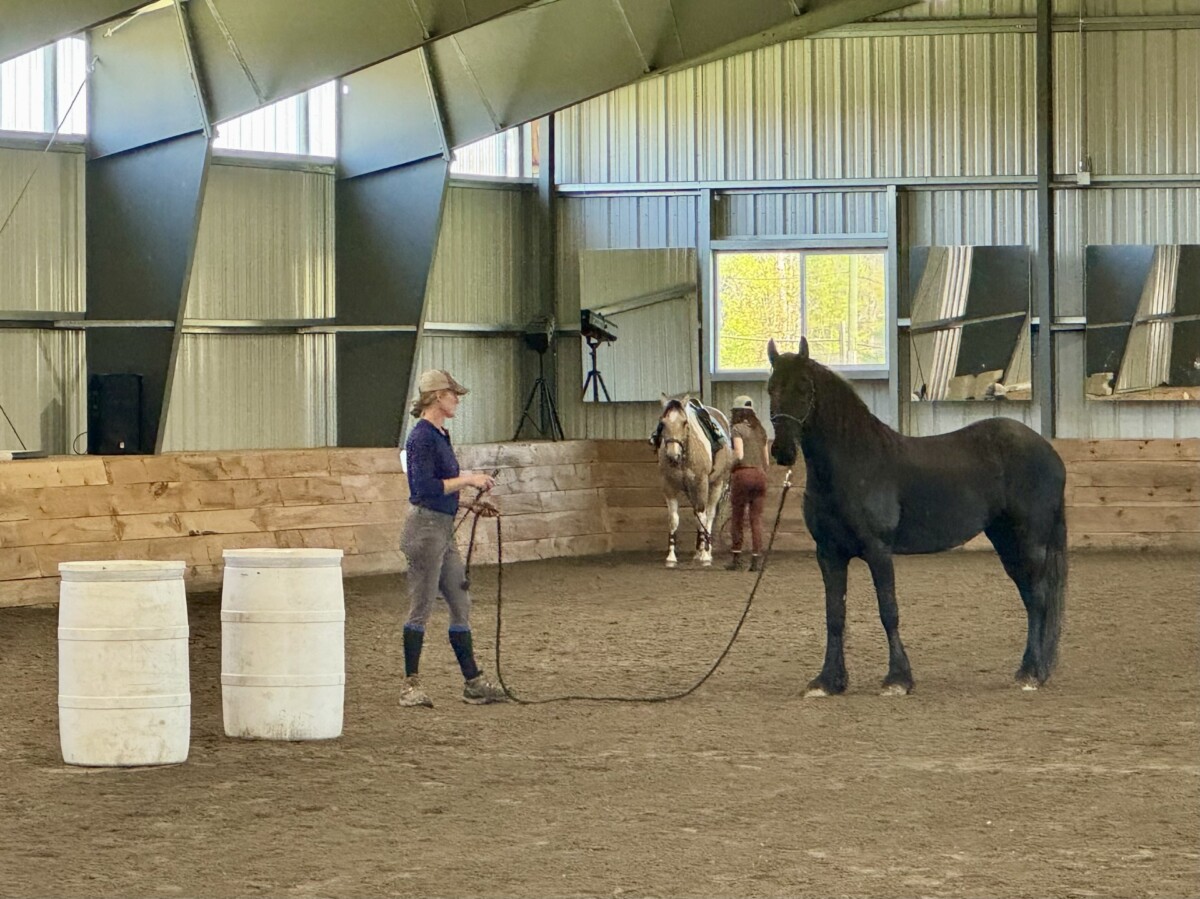
 I was fortunate to attend the 6th annual New England Spring Symposium in May, with clinicians Tik and Sinead Maynard. Over three days, we had group groundwork lessons with Tik, and ridden work over poles and cavaletti with Sinead. While I absolutely came away with new exercises to try and ideas on where I can improve my technique, my favorite take away was in the mindset side of working with horses.
Tik led us through an exercise of breaking a goal down into smaller steps. Take trailer loading, for example: our end goal might be to have our horse standing relaxed on the trailer. We can make a list of steps 1-10, with one being stand and look at the trailer from a distance, and 10 being our end goal of relaxation in the trailer. We might start on that list of steps, but then realize that in between steps one and two are 10 more steps such as leading skills: can the horse back up, draw forward, etc. This exercise reminds us that if something is too hard, we can always break it down into smaller steps. With this approach, no one gets frustrated, overwhelmed or over-threshold. Successes will also come quicker, which we can then reward and build upon.
Lessons with Tik were a masterclass in recognizing each tiny try, and rewarding it with a release and moment of rest. As he said often: we aren’t looking for huge improvements before we reward, a 1% improvement is enough! And if we can notice a .1% improvement, that’s even better! The key to having this level of timing lies in close observation of your horse, and in having a very clear idea of your goal. For example, if you are asking your horse to back up away from you, and you notice the tightening of their chest muscles as they prepare to rock backwards, you release on that. And then ask again. Then you release on one step back. If you’re directing them towards an object, notice when they look at it, and release on that. Then notice one step towards it, and release on that. Think of it like a game of ‘warmer, colder,’ where we release for the horse getting even the tiniest bit ‘warmer’ or closer to our goal. This encourages them and lets them know that they are on the right track.
This mindset keeps the human curious, observant, and seeking the earliest moment to release and reward the horse. If we can break everything down into smaller steps, the horse feels encouraged and motivated to keep trying. Of course if something feels easy, then we can always add layers of difficulty to increase the challenge. With this approach, neither horse or human will become frustrated or confused. The more tiny steps we can add in, the more easily the bigger pieces will slide into place.
Both Tik and Sinead met horses and riders where they were at, with zero judgement or expectation. Sinead is currently one of the selectors for the American Eventing team, and here she was helping nervous riders over trot poles. At one point she noted that when teaching someone, she never considers their level of skill or knowledge–there is no classification being made in her mind. Rather, she identifies what pieces she can help fill in for them that will make the most difference, and focuses there. This was a stunning reminder to me that it is never about our skill level or where we might rank in comparison to someone else. Even those at the top of the game are still taking lessons, trying to improve. There is no end point where we will finally be ‘good,’ or experienced enough– we’re all just at different points on the journey. I find this mindset to offer a profound sense of relaxation and freedom about my own work with horses, because it removes any sense of judgement or comparison. Wherever we are along the path is exactly where we should be! What matters is staying open, staying curious, and continuing to learn.


