

We recently had the wonderful opportunity to work with Libby Lyman. We are always looking to improve in our daily training and horsemanship skills, and Libby offers a unique perspective.
Libby’s work is based on the idea of becoming aware of what the horse is thinking. She teaches students how to ‘set up a problem’ for the horse to solve, thus ensuring that both horse and human are mentally involved in the process. Once you have the horse’s mind with you, the training pieces fall into place. We would agree completely with this, but our big question for Libby was, ‘how do you get the horse mentally with you?’
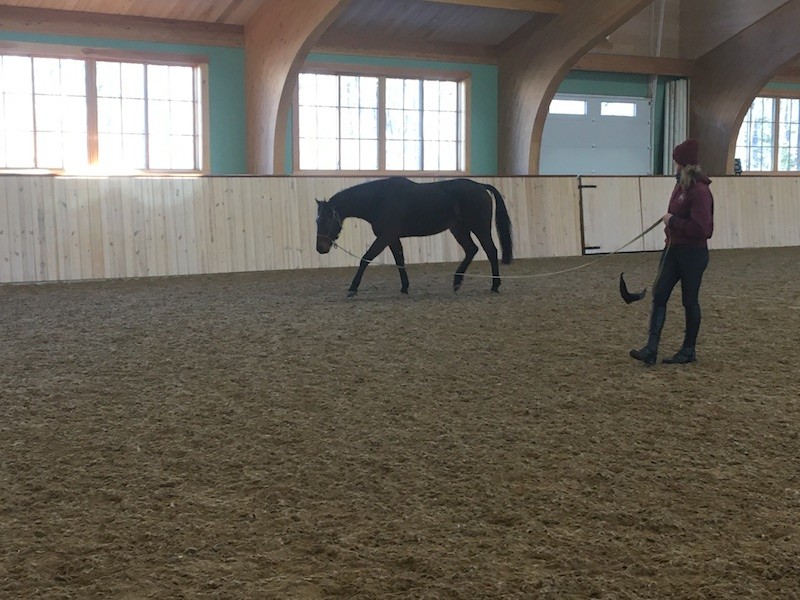
Libby reminded us that a horse is always seeking a ‘no pressure’ situation. Our job is to find a way to apply just enough pressure to get the horse to ‘set up a search’ for relief. To take the worry out of a horse, they have to be able to ‘solve the problem’ presented by the human. Solving this problem gives them immediate relief in the form of no pressure, and allows them to relax and feel confident. The key concept to keep in mind, said Libby, is that applying ‘pressure’ does not mean doing something TO the horse. Rather, you are trying to make certain actions less convenient (more pressure) and the desired action very convenient (no pressure).
This concept can be used when doing anything with a horse, whether in hand or under saddle. It doesn’t matter what you’re working on, the goal should be to have the horse mentally and emotionally with you. Libby explained that instead of focusing so much on what a horse knows, she wanted us to get excited about what a horse can figure out.
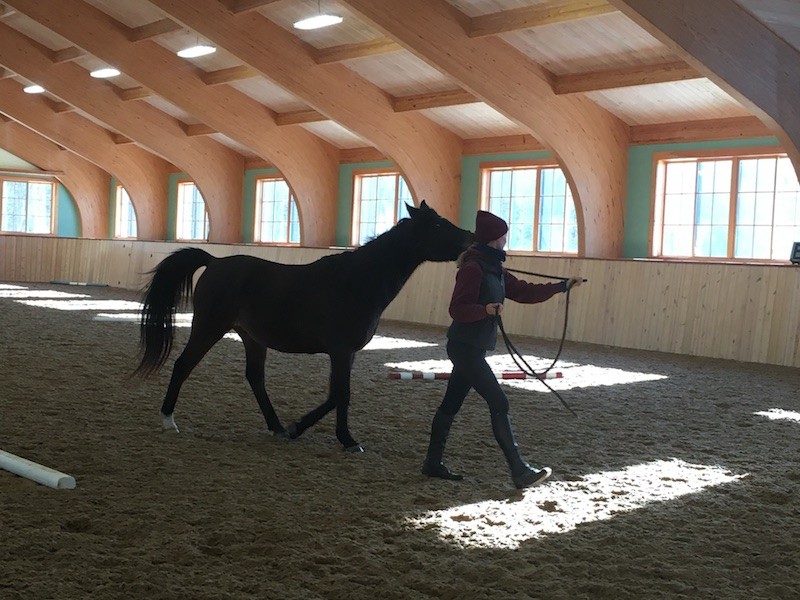
This was a challenging concept for us to grasp, so Libby coached us through various examples. For instance, if you trot off in the arena on a loose rein and don’t direct your horse, many will turn around and make a beeline for the gate. When this happened, Libby had us increase pressure (by bumping with our stirrups) at the gate, and stop bumping as soon as the horse thought about leaving the gate. Most horses would veer off, but then circle back and try again. However, it didn’t take too long before they decided that things got harder by the gate, and they would then find another spot in the arena where we immediately let them stop and take a break– no pressure. Rather than dictating, we were simply letting the horse figure out for themselves that there was no relief by the gate– that in fact it was more work over there. After letting the horse make that decision, we found they were much more engaged and responsive when we did pick up the reins again.
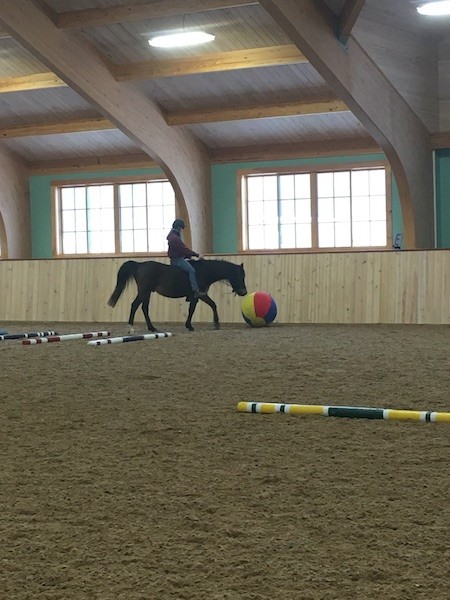
For horses that came out tense and distracted, Libby explained that tension is emotion, and once emotion lets go the tension will disappear. So again, the answer lay in getting the horse mentally ‘with’ the human. When riding a tense horse, Libby encouraged us to continually ‘change the pattern’ to get them thinking about us and with us. By using transitions, changes of directions, halts, etc to get the horse more engaged with the rider, we in time had a softer, more relaxed and responsive horse. Once again, the idea was to teach them how to solve the problem, through well-timed releases from pressure.
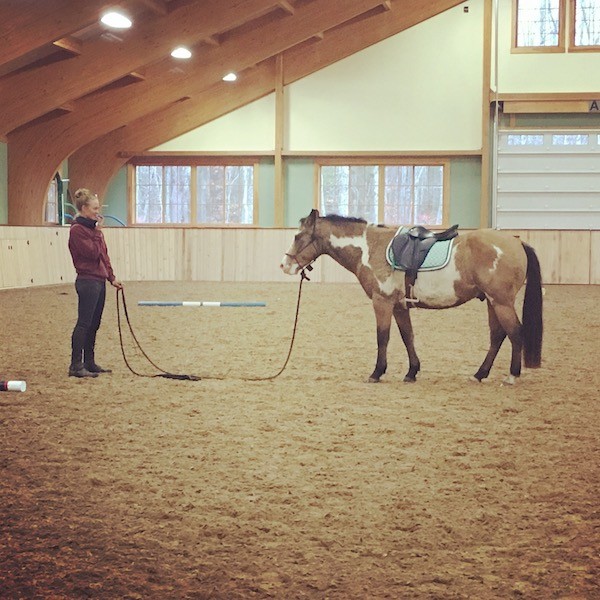
Often a new challenge will bring up tension, but then AS SOON as a horse starts to look for a solution to their problem, we need to give complete relief. This will build confidence and encourage relaxation. Libby reminded us often to reward the slightest thought or effort. She suggested that we experiment with releasing pressure sooner than we thought we should, and to keep in mind that the majority of our time with a horse should be spent releasing, and not applying pressure. She also reminded us of the importance of allowing ‘soak time,’ where a horse can stand quietly and absorb what has just been happening.
Timing of the pressure release is so important, and as a group we admitted to not always being sure if our timing was correct. Libby reminded us that we’re going to make mistakes, but that the important thing is to come in everyday with creativity, focus and kindness. We all finished the session with new insights, questions to ponder, and ideas to try out in our training, and we thank Libby for sharing her expertise with us.


