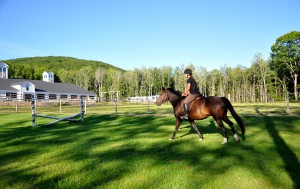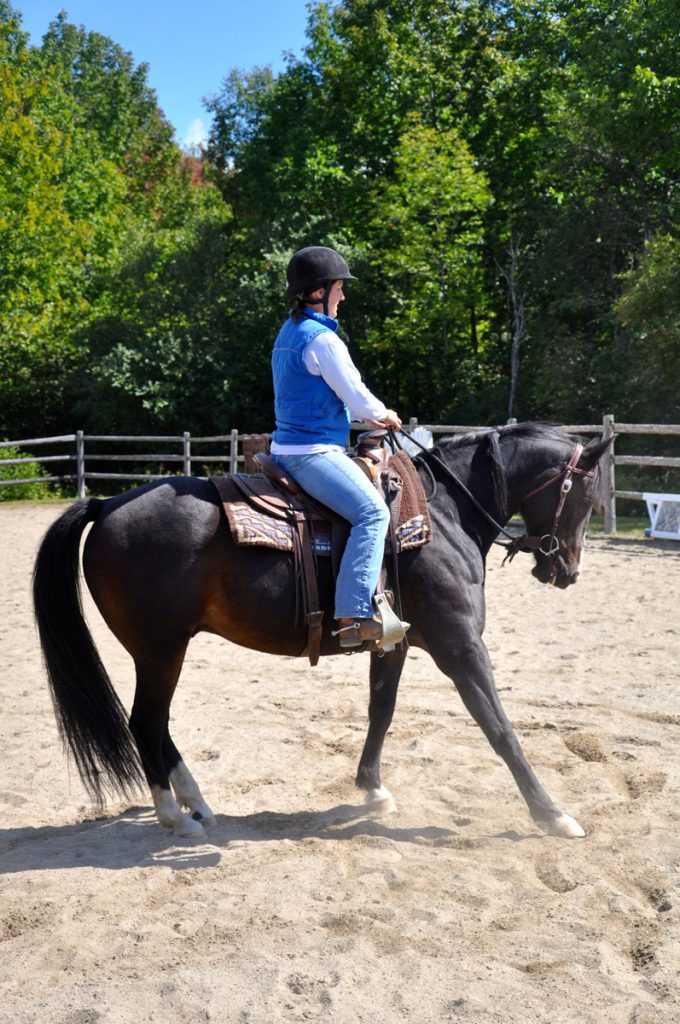

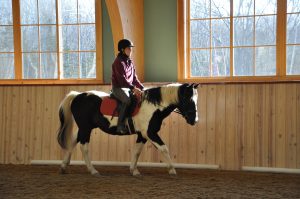
 Acadia and Baxter are now officially riding horses, as we sat on them both for the first time this past week. It’s always an exciting moment and marks the start of a whole new phase in the training process. Although we can learn a lot from handling and ground work, riding helps us to understand what previous experiences these horses have had and what we need to focus on moving forward.
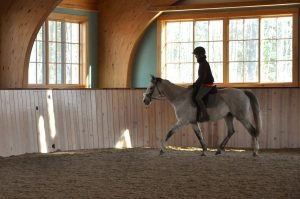 As outlined in previous posts, there are many steps to go through before we arrive at the point of sitting on a rescue horse for the first time. During the fours weeks they spent in quarantine, Baxter and Acadia were seen by the farrier, vet, dentist, and even got massages. Once out of quarantine and integrated with the rest of the herd, they spent two weeks working in the roundpen, on the lunge and in-hand. During the second week, we added saddles to the equation and continued with roundpen and ground work. It was not until the third week of training, once Baxter and Acadia were steady at the walk, trot and canter on the lunge, in the roundpen and were responsive to groundwork in hand, that we begin work under saddle.
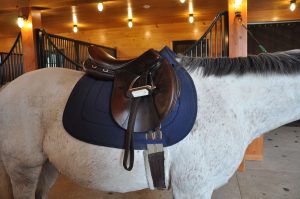
Choosing a saddle that fits each horse properly is a very important aspect of the training process. An ill-fitting saddle can cause soreness and physical issues, which will over time have a negative impact on the horse and his willingness and ability to work. When fitting an English saddle to a new horse we check to make sure that:
- The saddle sits correctly on horse’s back (just behind the shoulder blades so as not to impair movement)
- The saddle gives plenty of clearance at the withers (at least 2 or 3 fingers should fit between pommel and withers)
- The seat is level (not tilted forward or backward)
- The saddle tree is the right size for the horse’s shape (correct angle and width of tree points for horse’s back- too narrow may pinch the back, too wide may cause the front of the saddle to sit low on the withers)
- The saddle panels make even contact with horse’s back (so that a rider’s weight will be evenly distributed)
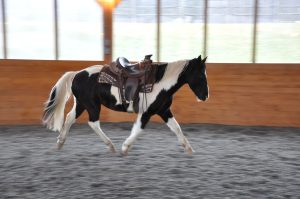
Many of our horses go in both English and Western saddles, as one of our trainers has extensive Western riding experience. There are many similarities between English and Western saddle fitting; with Western saddles we look at:
- Placement of the saddle (should not be too far forward on the horse’s back– typically the cinch should fall about 4 inches behind the horse’s elbow)
- Wither clearance (2 to 4 fingers’ worth between the horse’s back and the gullet)
- Shoulder clearance (should be able to slide a hand between fleece lining and the horse’s shoulder)
- Skirt fit (should follow the shape of the horse’s back and not extend past loins)
- And again, balance of the saddle on the horse’s back (seat is level, back of saddle does not ride up when cinched, etc)
As our horses gain weight and muscle the shape of their backs can change, and so it’s important to recheck saddle fit once or twice a year. When we need some extra guidance, we arrange for a saddle fitter to come out to the farm. Because a well-fitting saddle is so important to a horse’s progress and performance, it’s worth it to call in the professionals if we have questions or concerns. Of course, like many barns we have horses of all different shapes and sizes, and we likely won’t have the ideal saddle for every one that comes through our program. However, with regular assessments and different saddle pads or half pads when necessary, we can do our very best find a good fit for each individual horse.